
Automotive News Sept 5, 2024
Once banned '90s-era cars from Japan and Europe are gaining in the U.S. Some dealers are striking gold with the fast and furious generation.
By: Richard Truett, Automotive News
It's 8:37 on a Saturday morning. The driver of a gleaming white Nissan President backs the giant luxury sedan carefully into a parking space at a nearly empty shopping center. By 8:47 a.m., the cars start rolling in quickly.
Here comes a tiny red Suzuki Cappuccino. Two Toyota Aristos, a Mazda Lantis, a Toyota Crown Royal Saloon and an Autozam microtruck - a Suzuki-Mazda mashup - arrive next.
By 10 a.m., nine Nissan Skylines from the late 1980s and early '90s have maneuvered into their spaces and the shopping center parking lot is nearly full. At least 200 people are eyeing an array of vintage Japanese vehicles.
The star of this show is arguably an opulent black 1997 Toyota Century powered by a silent-running V-12 engine. The regal sedan, with a Japanese flag on its front bumper and white lace cloth privacy curtains on the side windows, seems perfect for Japanese royalty, corporate CEOs or high-ranking members of the yakuza.
You'd expect to see this array of vehicles at a cars-and-coffee gathering in Tokyo, Yokohama or Osaka. But we're not in Japan. We're in Waterford Township, Mich., a northern suburb of Detroit.
Of the roughly 150 cars in the parking lot, 26 are right-hand-drive JDM - or Japanese domestic market - vehicles that were not sold new here. They are models that were never offered in the United States.
Legal imports of 25-year-old cars from Japan and Europe have grown from fewer than 300 in 2009 to around 20,000 per year. As these imports grow in popularity in the U.S. among collectors, some enterprising dealers are looking to capitalize.
View Gallery
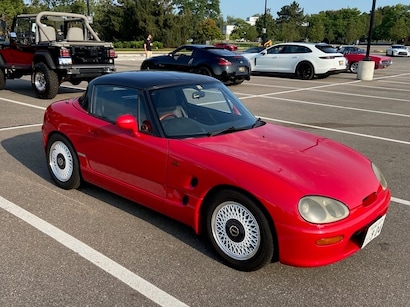
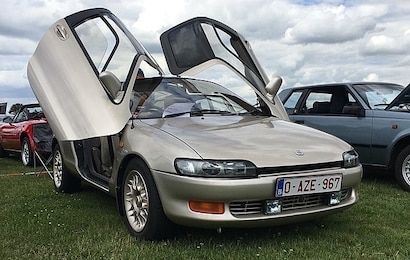
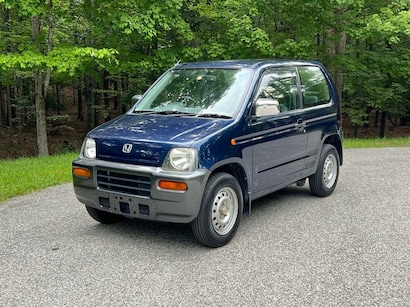
Fast-growing segment
Because these cars don't meet federal safety and emissions standards, they could not be registered in the U.S. until they turned 25 years old and were treated as collectibles. But each year, the pool of cars reaching that age grows and with it, private imports to the U.S.
"The '90s were such a great decade for Japanese sports cars and Japanese engineering. There are so many great [vehicles] that, in just the last five years, have turned 25 and are eligible to come in, and that's part of what's driving it," said Brian Rabold, vice president of automotive intelligence at Hagerty, the Traverse City, Mich., classic-car insurance company.
In fact, Japanese domestic market cars are one of the fastest-growing segments of the specialty used-car market. Dealers from California to New York and many states in between, as well as private buyers, are importing them by the thousands each year.
According to figures from two sources, 25-year-old cars from Japan and Europe are on track to set a sales record in 2024, reaching an approximate 20,000 based on import figures for the first seven months of the year.
The precise number of 25-year-old cars being imported is not clear. Importers submit a form claiming the 25-year exemption, but NHTSA changed that form around 2015 to include "motor vehicle equipment," which makes it impossible to separate complete vehicles from parts shipments for vintage cars. The number of 25-year-old cars shipped from Japan is not tracked by the Japanese government.
Hagerty, which monitors marine traffic, estimates 17,359 25-year-old cars will be shipped by ocean freight to the U.S. this year. But more arrive by truck and rail from Canada and Mexico. The number has been rising steadily. In 2010, Hagerty estimates, just 281 25-year-old cars were exported to the U.S.
Hagerty's estimates align with those provided by one of Japan's top exporters of used vehicles, Yamagin Corp., which specializes in exporting classic Japanese cars.
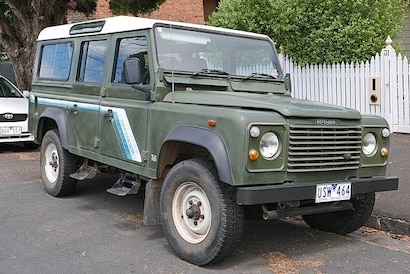
Several Japanese websites make purchasing and importing such vehicles and shipping them to an American port as easy as clicking a mouse. Old cars from the U.K. and Germany make up the bulk of the rest of the 25-year-old vehicles entering the U.S., with Land Rovers, Mini Coopers, BMWs and Porsches being popular private imports.
A monster importer
There is a Godzilla of Japanese domestic market cars in America. His name is Gary Duncan. He was a new-car dealer for 52 years until late July. Duncan, 72, unloaded his last two franchises - Honda and Hyundai dealerships - in part to focus his full attention on Duncan Imports, his thriving JDM used-car business that has stores in Smyrna, Tenn., and Christiansburg, Va.
A recent check of his inventory showed 706 vehicles in stock. Hundreds more are in Japan awaiting shipping or already on the water. He also sells classic American cars and a few older European models.

Duncan's life as a new-car dealer began with imported brands that appealed to customers looking for fun, small cars. British Leyland awarded him his first franchise in 1972, a Triumph store. He later added MG. Both brands were famous for their fun-to-drive budget sports cars.
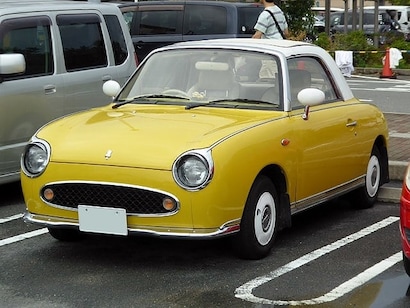
It was a trip to the 1989 Tokyo Motor Show that led to his current business dealing in JDM cars. The Nissan Figaro, a tiny retro-styled car patterned after postwar European subcompacts, stole that show and burnished an image in Duncan's mind. His clock started ticking when the Figaro went on sale in 1991.
"I saw them for the first time at the Tokyo Motor Show back when I was a Honda dealer," Duncan told Automotive News last month. "I had to wait 25 years. They only made them for one year, 20,000 total."
The day the Figaro was eligible for import to the U.S. in 2016, Duncan started importing them. And he hasn't stopped. He usually keeps 100 Figaros in stock. They are revered classics in Japan and Europe, and they have now earned a following here.
But a scan of Duncan's vast inventory shows something unusual - brand-new Daihatsu Hi-Jet microtrucks, which sell for around $27,000 and come with a warranty. The catch: They cannot be registered and titled for public roads. Duncan has carved out a niche selling these vehicles to farmers, golf course operators, industrial customers and hotels.
He also sells older JDM vehicles to rural mail carriers who need the steering wheel on the right. The vehicles sell well despite the fact they are a quarter-century old.
"It would blow your mind how nice a 25-year-old vehicle can be," Duncan said.
The condition of JDM cars is usually outstanding, dealers say, in part because of Japan's extremely strict annual inspections and low annual mileages. Most of the 25-year-old vehicles Duncan imports from Japan have between 40,000 and 60,000 miles.
Duncan said he imports around 60 vehicles per month. He estimates he's brought in 5,000 JDM vehicles since 2016, and he has no plans to slow down.
"It's more lucrative than selling new cars, not the volume, but the margins," he said. The power of the dollar versus the yen and the low resale price of old Japanese cars make them a bargain, even with ocean freight and customs charges.
All of Duncan's cars come with a Tennessee title. He doesn't dicker on the sticker price. And he recommends that buyers have their vehicles delivered to them and not attempt to drive them home.
He doesn't do tune-ups or replace worn-out tires, and he doesn't stock repair parts for the vehicles he sells. But with competition heating up, Duncan said he's considering offering a powertrain warranty on most vehicles.
While Duncan offers a wide menu of JDM vehicles, from tiny kei cars to fully loaded luxury sedans and SUVs, other big dealerships, such as TopRank International Vehicle Importers in Los Angeles and JDM Sport Classics in Three Rivers, Mich., specialize in Japanese sports cars.
Both offer services that make buying easier than it would be for an individual to privately import the car. JDM Sport Classics can arrange bank financing, said Seth Clock, sales manager. The store typically sells 225 to 275 cars per year, he said.
TopRank can modify certain Japanese cars to meet California's strict emissions standards so that the vehicles can be legally driven in the state. But that can add $10,000 or more to the purchase price.
Birth of a cottage industry
Before 1988, there was little government oversight into privately imported "gray market" cars. It was often far less expensive to buy a European market Mercedes-Benz or a Porsche in Europe and ship it to the U.S. than it was to buy the same model here that conformed to U.S. safety and emissions standards. Around 60,000 gray market cars were imported in 1988, the peak year before Congress passed the Imported Vehicle Safety Compliance Act. That spelled out strict procedures for bringing nonconforming vehicles into compliance, a job so expensive that it eliminated the financial advantages of private imports.
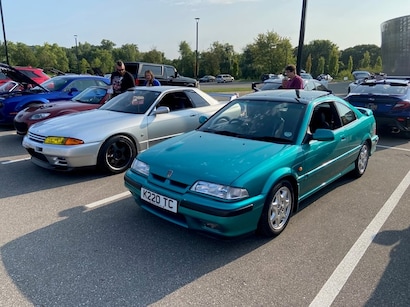
The bill contained a little-noticed sentence in a subsection stating that once a vehicle reaches 25 years old from the date of manufacture, it can be imported without having to meet U.S. emissions and safety standards. Throughout the 1990s and up to around 2010, just a few hundred 25-year-old cars were privately imported each year, most from Europe. That started to change when Japanese cars such as the Nissan Skyline, Honda Beat sports car and the Nissan Figaro started turning 25.
Now 25-year-old JDM cars, European market Land Rover Defenders, Rover Mini Coopers and vintage German cars are commonly seen on U.S. roads in nearly every city. A quick scan of Facebook Marketplace in the Detroit area using the search term "RHD" turned up a 1997 Nissan Skyline, a 1996 Nissan Cedric luxury sedan, a 1992 Honda City CZ-i, a Suzuki Alto Works RSR and at least a dozen more JDM cars.
JDM drivers
To be sure, few of the people buying these cars use them for their daily transportation. They fill the same role as having a classic American muscle car - it's a hobby that includes car shows, cruises and cars-and-coffee gatherings.
Eric Wuestenberg, 47, the driver of the white Nissan President, became interested in JDM cars in the 1990s when his Pontiac Trans Am was beaten in a street race by a hopped-up four-door Honda Civic. That led him to Japanese sport compacts and eventually buying a JDM car.
"The Fast and Furious movies just blew up the whole scene," Wuestenberg said. His family caught the bug, too. Wuestenberg's wife drives a 1990s Nissan Fairlady Z and his 20-year-old son owns a Toyota Aristo. All three cars were at the Waterford Township cars-and-coffee gathering.
The family's Japan market cars were all purchased from dealers, but Wuestenberg said he might buy the next one directly from a Japanese auction.
Philip Pinsoneault, 31, an aviation mechanic from Westland, Mich., and his wife, Tricia, do use their 1993 Mazda Autozam Scrum for more than car shows. The truck, which has a 557-cubic-centimeter three-cylinder engine and four-speed manual transmission, is used only in city driving, Pinsoneault said, to haul vintage furniture and other items bought at garage sales and elsewhere. They bought the kei truck last year from Duncan Imports for $8,000.
It was not fun at first. The Scrum's fuel pump died on the way home from Tennessee, and the Michigan Secretary of State office initially refused to register the car and provide a license plate, something owners of other small JDM vehicles in other states also deal with.
"I wanted a vehicle that we could haul stuff around in," Tricia Pinsoneault said. "I am used to having an SUV and I like getting vintage furniture. We already have a car. We don't like American trucks. They are just too big and they waste fuel. This was more in our price range."
The Pinsoneaults also like the attention the truck gets, which is one of the main reasons why, Duncan says, JDM cars' popularity has grown so much.
"That's what I love about these cars," Duncan said. "You can buy you a car for under $20,000 and go to cars-and-coffee. The guys next to you can have a $1 million Ferrari or a $300,000 Porsche. But everyone is over there looking at your JDM car."