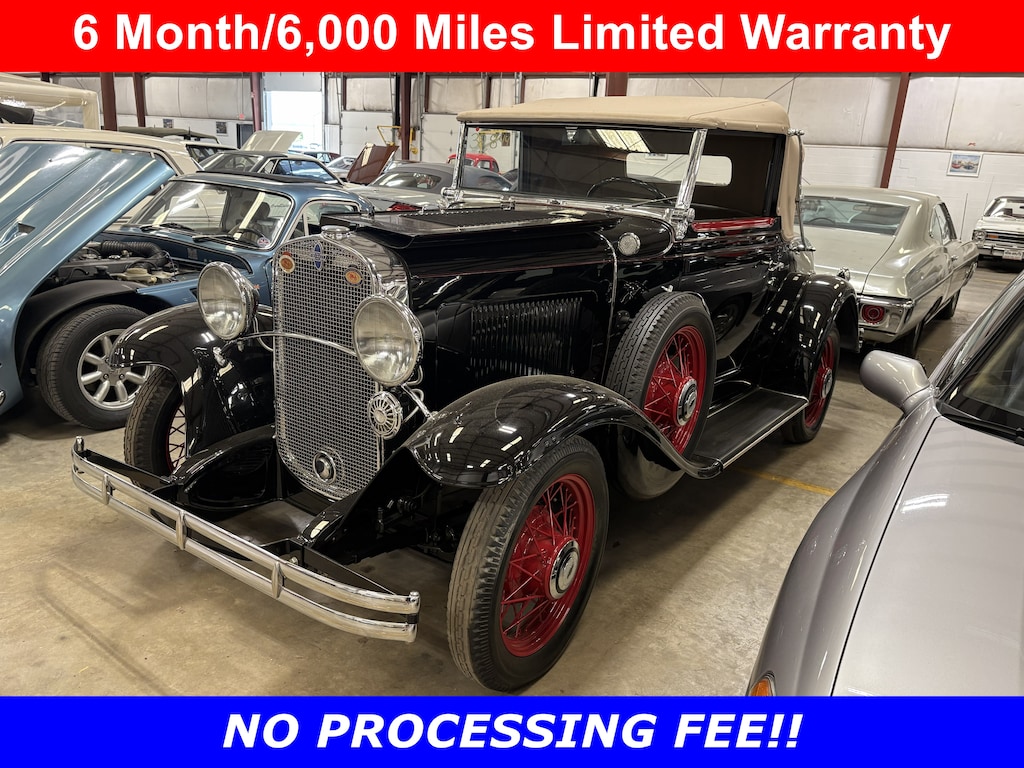
The 1931 Chevrolet Series AE Independence is a historically significant American vehicle that helped Chevrolet reclaim first place in the US car sales race against Ford during the Great Depression. Introduced in January 1931, it replaced the 1930 Series AD Universal and was produced for only one model year.
The defining feature of the Series AE Independence was its powertrain, which easily outclassed contemporary four-cylinder competitors:
- Engine Type: The legendary "Stovebolt Six" 194 cubic-inch (3.2L) overhead-valve inline six-cylinder engine.
- Power Output: Delivered 50 horsepower at 2,600 RPM (some heavily upgraded or modified blocks reached higher ratings).
- Transmission: 3-speed manual transmission.
- Top Speed: Capable of reaching speeds between 80 to 85 mph depending on the body style.
- Engine Type: The legendary "Stovebolt Six" 194 cubic-inch (3.2L) overhead-valve inline six-cylinder engine.
- Power Output: Delivered 50 horsepower at 2,600 RPM (some heavily upgraded or modified blocks reached higher ratings).
- Transmission: 3-speed manual transmission.
- Top Speed: Capable of reaching speeds between 80 to 85 mph depending on the body style.
Despite the ongoing economic downturn, Chevrolet introduced several luxury and technical upgrades while keeping prices low:
- Extended Wheelbase: The chassis was stretched by two inches to a 109-inch wheelbase (though some base frames sat at 107 inches), providing a smoother ride.
- Visual Anchors: It debuted the famous "eagle" radiator ornament and a stylized, curved tie-bar connecting the front headlights.
- Standard Wire Wheels: Wire-spoked wheels became standard equipment for the first time, replacing older wood-spoke designs on main trims.
- Body Construction: Utilized Fisher body styling with a mix of steel panels over a structural wooden frame.
- Available Styles: Offered in a massive variety of configurations, including 2-door and 4-door sedans, sport roadsters, 3-window or 5-window coupes, and 1/2-ton pickup trucks.
- Extended Wheelbase: The chassis was stretched by two inches to a 109-inch wheelbase (though some base frames sat at 107 inches), providing a smoother ride.
- Visual Anchors: It debuted the famous "eagle" radiator ornament and a stylized, curved tie-bar connecting the front headlights.
- Standard Wire Wheels: Wire-spoked wheels became standard equipment for the first time, replacing older wood-spoke designs on main trims.
- Body Construction: Utilized Fisher body styling with a mix of steel panels over a structural wooden frame.
- Available Styles: Offered in a massive variety of configurations, including 2-door and 4-door sedans, sport roadsters, 3-window or 5-window coupes, and 1/2-ton pickup trucks.
Owned by the previous owner for 58 years
AACA Winnner
All original OEM parts used to restore
